.png)
How to tackle resourcing challenges in data migration | Episode 6
27 August 2025
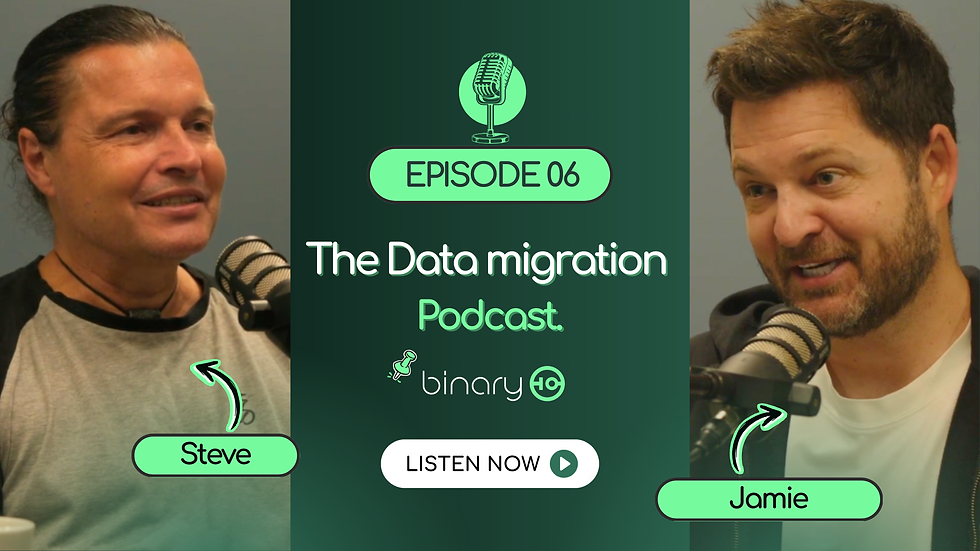
Welcome to Episode 6 of The Data Migration Podcast by Binary10!
This time, James and Steve tackle one of the trickiest parts of any data migration project: resourcing. From bottlenecks with key SMEs to balancing BAU with project demands, they explore why getting resourcing right can make or break a transformation. If you’ve ever struggled with stretched teams, clashing priorities, or last-minute surprises, this episode is for you!
In this episode, James Blake (CEO) and Steve Smales (COO) dive into one of the most overlooked yet critical aspects of digital transformation: People.
From bottlenecks with key SMEs to balancing BAU with project demands, the conversation explores how poor resourcing decisions can derail even the best plans. But more importantly, James and Steve shared some practical strategies to avoid burnout, keep priorities clear, and get the right people in the right roles at the right time.
If you’ve ever wondered why your project team always feels stretched thin, or how to prevent resourcing nightmares before they begin, this episode is for you.
In this episode, we discussed:
Resourcing is often the biggest challenge in data migration.
Assuming time will “just fit” leads to project risks.
How staff juggle day-to-day work and project needs.
Holidays and peak business cycles can derail plans.
The value of having the right people in the right roles.
How back-up plans and support teams stop burnout.
Good planning = happy teams and smoother delivery.
EPISODE TRANSCRIPTION:
Disclaimer: This transcript was generated by an AI tool that did its best, but it's never met different British accents it could fully decode. Expect a few funny mistakes. Enjoy!
[00:00] - James B
Hi there, welcome to the Binary10 podcast. My name is James Blake, I'm the CEO of Binary10.
[00:06] - Steve S
And my name is Steve Smales and I am the Chief Operating Officer.
[00:11] - James B
Hello Steve.
[00:12] - Steve S
Afternoon Jamie.
[00:13] - James B
Yes, how are we doing? I'm excited about today.
We've got one of those topics where we talk a little bit negative, challenges. And obviously data migration, what else? But specifically today we're going to talk about the challenges of resourcing on these projects. Always a problem.
Not just for DM, but resourcing in general on these types of digital transformation delivery projects. Well, where do we start? There's a few areas we go into here, but one that I think would be a good place to start is, how much effort should you put onto resourcing and managing people's time in these deliveries? In recent years, I see it so much less formal and people just assume that people's time will all come together and it'll be the right amount of time and it'll just all fit without actually putting the effort in. Many, many years ago, project plans with people's hours being tracked on a daily basis.
What is the right level there? How do we get that right?
[01:16] - Steve S
Well, I think these sort of projects, particularly when they start off, they're quite fluid. In terms of plans, things change quite rapidly. I don't think it's worth going to the huge effort to start micromanaging people's time.
I think what is really important, and we've spoken before about data migration strategies, is when you do a data migration strategy, you identify all the people that are going to be needed and at least give an estimate of what percentage of their time you think is going to be needed on the project, so that there's upfront visibility of that. And also, at what points that time is needed, because certain people might be needed at certain key points in the project, but otherwise are not needed. Other people might be just on call, as such, particularly like IT infrastructure department.
You might need them upfront and then just if there's any issues afterwards. So again, it's not a one-size-fits-all. It will be different for the different people.
I think the other thing that is always problematic in terms of resourcing during DM projects or programmes, the whole programme, is around bottlenecks for the key SMEs. They're always in demand for testing, training, for data migration, reconciliation, or for the data cleansing. So key people, that's always a problem, that too many people want a piece of them.
And something we always advise people is start thinking about that upfront. Do you need to backfill them? Do you need to bring in a contractor to do something to take over part of what they're doing on the programme or their BAU? Because it's a huge problem we always face is the core sort of key SMEs are always sort of, I suppose, struggling between BAU and working on the project. Yeah.
[03:07] - James B
And I think you're right. And I think that's a great place to start. And it's a difficult one.
And it must be difficult for project managers or PMO offices where, firstly, you're trying to define the responsibility of that resource or that individual. So it's all clear. So we understand what are you doing on this project? What tasks do you do? What are your responsibilities? But then the next challenge is just trying to be open and honest about, is this and do you have enough time here? You constantly hear people saying, oh, I don't have enough time.
But it's kind of brushed away, isn't it? Or just, oh, but somehow you'll make it work. And I think it's so... We did a podcast around planning and the importance of planning right at the start. And obviously, the resourcing links into that massively.
So I think, and you're right, you've almost got two levels, haven't you? You've got those people that are full-time, dedicated to delivering the project, which has got its own challenges. And you mentioned one of them there, which we'll come back to. But then you've also got those people that are part-time, that they have BAU delivery.
And that's where you have that extra dimension of managing priorities of, well, I know the project needs me, but actually the business needs me to do this activity today. And the thing is, I think this is where investing in a project management office and really dedicating people to looking after people and managing their time is so important. Because otherwise, you can really demotivate people because they get a bit lost with their priorities and which should take priority.
And it's so important that we can take that away from them.
[04:34] - Steve S
Yeah, because people naturally get stressed out when they're being dragged in too many different directions at the same time and they're having to work really long hours to get everything done. And it's certain key points as well.
It might not be all the way through, but you might have someone, say in finance, who's working on quarter-end or year-end at the same time that there's a delivery required for the programme. And that's going to cause you problems. So you need to look at those pinch points.
Where are people going to be most heavily affected by the BAU? Or where is BAU, in general, going to be a difficult time for doing project work as well? So I'm thinking maybe with retail, you have peak trading in November, December. You don't want your key SMEs having to do project work when they should be doing key company BAU at that point.
[05:28] - James B
I agree.
And I think it's the activity for success, maybe, let's call it, is similar to a plan where, for me, you come out of a planning session and you ask all your leads of all your streams, can you deliver your stream and does this plan work? If everyone puts their hands up, you're off to a great start. But it needs to be extended. The team leads need to be empowered to speak to their team, to show them the low-level plan, the times that all their teams required and map out the whole journey to make sure that the team sign up to it.
And if they don't, then that's where you might need to add resource or work around or whatever you need to do. But that lead then needs to come back to say, yes, my team is bought into this. We've gone through the resource plan and they're happy that they have the capacity to deliver what's required.
And it's difficult, isn't it? Because I think sometimes some of these conversations can be difficult and people worry. Everyone works at a different pace and you don't want to be seen to be the person that's not maybe contributing enough or whatever it might be. But it's so important that we be brave enough to have these conversations.
And if we can get that and if we can start there, we're off to a great start, but it still needs to be managed, right?
[06:34] - Steve S
Absolutely. I think you're right. We need to sort of encourage that honesty about plans and challenge plans and challenge people's holidays.
Oh, holidays. Oh, my God. I know that's something you were saying, so we've spoken about this before.
I had one recently where one of the key guys in the data migration team was actually on holiday during the dry run. And I wasn't aware of that. I hadn't been made aware of that.
And I was the lead on that project. And it's like, why was this allowed to happen? And why wasn't I informed? So, but you were saying the opposite. Quite often, the holiday is, you know, you've taken holiday, no one's ever challenged that.
[07:17] - James B
Well, it's the good old, I'm sure everyone can resonate with this, but the good old holiday tracker. Oh, could you fill in your holiday tracker, please? Could you, you know, lock down? You know, I remember, you know, quite a few years ago now, but doing it many times, you know, and you go on the calendar and go, yeah, I'm going to put my holidays in here. But it was almost done without consultation.
So, it's almost a free, yeah, just put your holidays in, you know, where I think, you know, the leadership should come straight out and go, look, these are our key points in the program. You know, please try and avoid that holiday where possible. But if you, if they've already got it booked, you're always going to have a scenario where you're going to have to resolve it, but you don't want multiple ones otherwise it's going to kill you.
But I swear, I filled out holiday trackers all my life, and not once has anyone come to me and said, oh, so you're on holiday then, or, you know, or, you know, you'll have a conversation. Oh, yeah, I've got my holiday next week. And they go, have you? I didn't know you're on holidays.
Did you look at the tracker? Oh, what tracker? You know, and it's, it's so important, you know, it's a bit like lessons learned, which we'll talk about in another podcast. But this is a valuable kind of asset, the holiday tracker. So, you know, I'm not saying don't have them, I'm just saying use them properly, you know, and make sure that you overlay that to your plan.
You know, maybe it's, you know, maybe I'm being a bit unfair, maybe sometimes it's just handy to have a holiday tracker to reference so that people can make plans and, you know, like validate against it. But yes, you know, I just get frustrated when we have these objects, you know, these objects, these artifacts that just aren't really used. It's just like, well, we should have a holiday tracker, so let's fill it out.
But no, use it to your value and make sure that, you know, that you've got the right coverage, you know, and avoid the surprise that you just said, which is you're about to catch about, oh, sorry, but so and so's on holiday, we can't do that for you. Yeah,
[08:54] - Steve S
but I'd even extend on that and say start using it not just for holiday, but for key business activity, where you've got certain, you know, weeks or, you know, periods in the year or during the lifetime of the programme, where, you know, you've got key BAU activity, put that in the chart as well. Yeah, so that it's known about.
[09:12] - James B
Yeah. And I think it's important, like, you know, things like holidays, you know, it's different in different areas, obviously, you know, I'm going to quote the public sector here. But a lot of the times, you know, July and August, it's good months, they don't naturally tend to be year ends, or, you know, or maybe something is all going on within the workplace.
But actually, it's when pretty much everyone takes their holiday, especially, you know, in public sector. So, you know, when I've been coming into projects, you know, before, and you know, when you go live, oh, we're going live at the end of July. I'm like, why? Wow, because it's the it's the bit when not a lot happens.
And it's like, well, yeah, because a lot of people go on holiday, you know, so you've really got to factor that in, you know, you're sort of setting yourself up for a failure early on.
[09:52] - Steve S
Yeah, absolutely. Yeah, no, I think I think we've sort of covered that really haven't we? I can try and think if there's anything else we need to think about resourcing, DM resourcing.
[10:02] - James B
Yeah, I think I think the other thing I'd like to mention just before we finish out is obviously just making sure you resource properly. Yeah, you know, and I don't want to, I don't want to call out any, you know, but again, this is just from my experience. And I'm sort of looking at some of those bigger companies, I won't name them.
But it's very easy to just, you know, in it, you know, we need testers, we need data migration people, you know, we need business analysts, you know, we need people reconciling data. All of these are different roles, different skills. But I don't know what it is.
I don't know if you feel the same. But in it, it's almost like if you can do one of those jobs, you get it. So you can do the other one, you know, oh, I do data migration today.
But actually, on this project, I'm going to do a bit of testing. No, you know, it's, you know, have the right skills, the right experience for the right role. And it's so important that because you wouldn't see that in any other industry, you wouldn't sort of say, Oh, well, I've got my electrician, I've got my plasterer, I've got my brickie, I've got my labourer.
Oh, actually, labourer, can you go and do the electric wiring today? Because you do building work? Yeah, no, you know, and it's amazing how in it, I think that people don't get that, you know, we're all doing individual trades here, and we all have our expertise. So I think that, you know, it's, it sounds obvious, right? But get the right people for the right responsibility. You know, I see, I see too many people almost taking on roles, because it's a job.
And they kind of it's in their world. So they kind of understand it. And we all want work, we all want jobs.
But, you know, it's obviously on their part, they shouldn't be taking that role if they're not qualified. But at the same time, you shouldn't just be putting someone in a role because you've ticked a box. And it's got to be you know, you have to put the effort in and make sure you take the care and you get the right people doing the right work.
[11:44] - Steve S
Yeah, especially in key roles, you don't want someone who's learning on the job, you want someone who's done it before. And the other thing actually sort of springs to mind when you're sort of talking about getting the right, not just the right people, but the right number of people. It's quite often we see that there is a lack of cover.
So if someone comes down sick, there's no there's nobody else to fill in. Because you're already down to the bare bones in terms of what you need to deliver. So you need to think about that resourcing in terms of what happens if someone goes off? What happens if someone resigns? Someone wins a lottery? You know, what are you going to do? So I think that is, I think, pays dividends to sort of think about that up front.
[12:22] - James B
Absolutely. No, no, brilliant. Well, I think you're right.
I think we have covered that pretty well there. And hopefully that was useful. And I'm sure you know, some of these challenges resonate with you.
And it'd be great to get some feedback on similar challenges other people have faced, or maybe what they've done to, you know, to sort of prevent these things from happening. I think I'm still keen to explore, you know, what is the right tool? What is the right level of detail to go into to manage your resources, you know, and, and what things are, you know, people have found the most effective and have worked really well on on their projects.
[12:51] - Steve S
Yeah, it's getting that balance right, isn't it? I think.
[12:54] - James B
Yeah, no, absolutely. No, really good. Well, thanks, Steve.
And I'll see you next time.
[12:58] - Steve S
See you next time.
We really hope you enjoyed this episode.
Thank you for joining our podcasts. If you want to see more, please like and subscribe.